



Audionotes vs Summary AI

Audionotes vs Summary AI

Choose Audionotes if you want one tool for voice notes, summaries, idea capture, content drafting, and multi-format input. Choose Summary AI if your main need is capturing meetings, transcribing them, and getting fast AI summaries afterward.

Audionotes vs Summary AI

Key differences in 30 seconds


Audionotes

Summary AI

Best for

Notes you can revisit, search, and build on, from voice, text, or any source

Meeting transcription and AI meeting summaries

Starting price

$19.99–$29.99 (Monthly), $89.99–$129.99 (Annual)

$5.99–$8.99 (Weekly), $17.99 (Monthly), $79.99–$99.99 (Annual)

Free Plan

Yes, unlimited number of notes with 1 minute recording limit

Yes, 2 free notes and a 3-day free trial

App Store rating

4.8/5

4.72/5

First released

January 2024

December 2024

Inputs

Audio, Video, Image, YouTube, Text

Audio, Video, PDF, Live Meetings

Exports

Markdown, Text, Audio, Webpage

Audio, Video, PDF, Live Meetings

Platforms

iPhone, iPad, Android, Web

iPhone, iPad, Android, Web

Integrations

Notion, Zapier, WhatsApp

Zoom, Google Meet, Microsoft Teams, Google Calendar, Outlook

App Languages

English, Español, Deutsch

English

Privacy

End-to-end encryption and GDPR listed

GDPR, ISO, and CCPA listed

Choose Audionotes if...

You want more than a meeting recorder

You want more than a meeting recorder

you care about flexible inputs like voice, text, images, video, and YouTube

You care about flexible inputs like voice, text, images, video, and YouTube

you want more export flexibility, especially Markdown and Word

You want more export flexibility, especially Markdown and Word

you want a tool that works for students, creators, solo professionals, and personal knowledge capture

You want a tool that works for students, creators, solo professionals, and personal knowledge capture

Choose Summary AI if...

Your main use case is meetings

You want live transcription, meeting summaries, and meeting assistant workflows

You need native support around Zoom, Google Meet, Teams, Outlook, and Google Calendar

Speaker diarization matters more than broad input flexibility

What users are saying

We collected the most recent App Store reviews available for each product (March 2026) and independently coded every review by theme: accuracy, reliability, pricing, and usability. The summary above reflects aggregate patterns across the full set. The quoted reviews were selected as the most representative of each product's top-cited praise and top-cited complaint, chosen for typicality, not extremity.

Audionotes logo

Audionotes has built a loyal following among professionals who spend a lot of time in meetings and want reliable summaries without babysitting a recording. Users consistently praise the transcription accuracy, the summary quality, and how well it holds up with multiple speakers in noisy environments. Reliability comes up often: the app works consistently across mobile and desktop, and the dev team's responsiveness to issues has earned trust over time. The main friction some users mention is wanting more control over when the AI kicks in, rather than it processing automatically every time.

TOP PRAISE

"I have been using Audio Notes almost every day now. And it has been a game changer. From meetings to ideas to to-do lists and everything in between, I extensively use Audionotes. Highly recommended!"

COMPLAINT

"Tried to purchase an annual plan numerous times with every different payment option available and every time there was an error."

Summary AI logo

Summary AI appeals to users who want quick meeting summaries without the overhead of more complex tools. When it works, the transcription is accurate, the summaries are useful, and the Apple Watch integration is a nice convenience. The trouble is consistency. Users report uploads that refuse to work, transcriptions stuck in infinite processing loops, and recordings that vanish entirely with no recovery option. Key features like YouTube summarization apparently stopped working after the trial period, and billing complaints about being charged immediately after clicking a free trial are common. The idea is sound, but the reported inconsistency raises reliability concerns for important workflows.

TOP PRAISE

"The summaries are fantastic! Very accurate."

COMPLAINT

"I recorded a full day work session and when asked for the summary the app said couldn't do it, recording too long!!!!"

Real-world benchmarks

30-minute two-speaker English conversation with moderate background noise, tested March 2026 by the Audionotes team. Transcription accuracy scored by a human evaluator; summary quality scored by an LLM judge against a fixed rubric; recording reliability derived from App Store review patterns. Full methodology and scoring rubrics.

MAX RECORDING

180 min

Audionotes

Undetermined

Summary AI

TRANSCRIPTION

9/10

Audionotes

6/10

Summary AI

SUMMARY QUALITY

9/10

Audionotes

7/10

Summary AI

OFFLINE CAPTURE

Yes

Audionotes

Limited

Summary AI

SPEAKER DIARIZATION

Yes

Audionotes

Yes

Summary AI

RELIABILITY

8/10

Audionotes

4/10

Summary AI

Takeaway: Audionotes delivered more consistent output quality and higher transcription accuracy, while Summary AI showed more variability across the same recording.

Feature-by-feature comparison

Recording

Audionotes logo

Summary AI captures meetings through a calendar-connected AI assistant that joins Zoom, Google Meet, and Microsoft Teams sessions automatically. It also supports audio file upload for asynchronous transcription, useful for processing recordings from external calls; Audionotes adds image, YouTube, and text capture for a broader non-meeting input surface.
Winner : Audionotes

Transcription

Audionotes logo
Summary AI logo

Summary AI transcribes meeting audio with speaker diarization and time-stamped highlights, producing a labelled transcript suitable for structured post-meeting review. Audionotes transcribes across more content types and recording conditions, but Summary AI's meeting transcript quality and speaker separation are purpose-built for structured call analysis.
Winner : Summary AI for meetings; Audionotes for general workflows

Summaries

Audionotes logo
Summary AI logo

Summary AI generates structured post-meeting summaries with key decisions, action items, and follow-up questions, formatted for business handoffs rather than personal note-taking. Audionotes generates more general-purpose summaries and mind maps that work across a wider range of input types, including voice memos and YouTube content.
Winner : Depends on use case

Chat and reuse

Audionotes logo

Summary AI lets you query past meeting transcripts and export summaries to email or team channels. Audionotes supports AI chat across all note types, voice memos, images, YouTube, uploaded files, not just meeting recordings, giving it a broader second-life surface for mixed-use workflows.
Winner : Audionotes

Organization

Audionotes logo

Summary AI organises around meetings, projects, and participants, with search across the meeting history. Audionotes uses general-purpose tags and folders across mixed content types, more flexible for personal knowledge management but less structured for a team meeting archive.
Winner : Audionotes

Course Material and File Uploads

Audionotes logo
Summary AI logo

Summary AI accepts audio and video file uploads for transcription, including recordings from calls the bot did not attend. Audionotes accepts audio, YouTube links, images, and text, a broader ingestion surface, though Summary AI's upload workflow is specifically optimised for meeting recording formats.
Winner : Depends on input type

Export

Audionotes logo

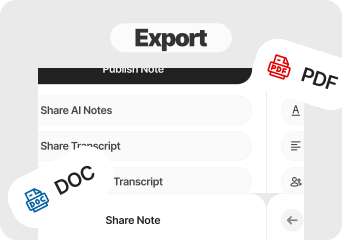
Summary AI exports meeting summaries and transcripts as PDF and DOCX, with direct email and Slack distribution for sending post-meeting notes to participants automatically. Audionotes exports as Markdown, Text, PDF, and Word, similar formats but without the built-in team distribution layer to attendees.
Winner : Audionotes

Online Meetings

Summary AI logo

Summary AI's meeting assistant auto-joins calendar-linked calls and generates a post-meeting package including transcript, summary, action items, and decisions. Audionotes has no meeting bot; recording is manual or by file upload, which avoids the bot-in-the-call dynamic but requires you to initiate recording yourself.
Winner : Summary AI

Integrations

Audionotes logo
Summary AI logo

Summary AI integrates with Zoom, Google Meet, Teams, Google Calendar, and Outlook as its primary connectivity layer, with GDPR, ISO, and CCPA compliance listed in its documentation. Audionotes covers Notion, Zapier, and WhatsApp, a different set of outbound connections focused on personal workflow automation rather than enterprise meeting distribution.
Winner : Depends on workflow

Privacy and security

Audionotes logo
Summary AI logo

Summary AI lists GDPR, ISO 27001, and CCPA compliance in its security documentation, a broader compliance stack than most consumer note-taking tools. Audionotes offers GDPR compliance and end-to-end encryption; for users with strict enterprise compliance requirements, Summary AI's ISO certification may be the deciding factor.
Winner : Depends on requirements

Best pick by persona

Find your workflow, find your tool.

Teams with ISO or CCPA compliance requirements

Teams with ISO or CCPA compliance requirements

Choose : Summary AI
Why? : Summary AI lists GDPR, ISO 27001, and CCPA compliance, a broader enterprise certification stack than Audionotes, which covers GDPR and end-to-end encryption.

Distributed teams who share meeting notes by email

Distributed teams who share meeting notes by email

Choose : Summary AI
Why? : Summary AI delivers post-meeting summaries directly to all attendees by email, Audionotes has no built-in participant distribution.

Students and lecture note-takers

Students and lecture note-takers

Choose : Audionotes
Why? : Summary AI is a meeting tool only, no useful workflow for lectures, voice memos, or any content outside calendar-linked calls.

Content creators and mixed-media note-takers

Content creators and mixed-media note-takers

Choose : Audionotes
Why? : Audionotes ingests YouTube links, images, and uploaded files alongside voice, Summary AI only processes audio from its meeting assistant.

Solo professionals recording calls without a bot

Solo professionals recording calls without a bot

Choose : Audionotes
Why? : Summary AI requires a bot participant in the meeting; Audionotes records manually on mobile with no third-party joining the call.

Users choosing on annual cost

Users choosing on annual cost

Choose : Audionotes
Why? : Summary AI is cheaper annually than Audionotes, the right trade-off if your only capture mode is online meetings and you do not need broader input types.

Pricing and value

Audionotes logo

$8.33

/month

Billed Annually - $99.99/year

  1. Audionotes is better when you need a general AI note-taking tool, not just a meeting summarizer.

  2. Its biggest strengths in this comparison are broader input flexibility, broader export flexibility, and a better fit for students, creators, solo professionals, and personal knowledge capture See Audionotes meeting note features →

  3. Audionotes offers a free plan and paid plans starting at $19.99/month or $89.99/year.

  4. Audionotes gives you broader product coverage per subscription.

Summary AI logo

$17.99

/month

$79.99/year

  1. Summary AI is better when your core workflow is meeting-heavy.

  2. Its clearest strengths are live transcription, speaker diarization, direct alignment with Zoom, Google Meet, Microsoft Teams, Calendar, and Outlook, plus a product experience built around meeting recap speed.

  3. Summary AI has a free plan, with paid plans at $17.99/month or $79.99/year.

  4. The simple tradeoff is this: Summary AI has the lower annual entry price.

Known limitations

No tool is perfect. Here's what to expect.

Audionotes logo
  • No native meeting bot or automatic calendar joining

  • No direct integrations with Zoom, Google Meet, or Teams

  • Collaboration and sharing features are more limited than dedicated meeting tools

  • Stronger as a personal capture tool than a team workflow hub

Summary AI logo
  • Primarily focused on meetings, with less flexibility for general note-taking, content creation, or multi-format input

  • Limited support for non-meeting inputs like images, YouTube videos, or mixed-media note workflows

  • Export options are more restricted compared to tools that support formats like Markdown or Word

  • Free plan limits and usage restrictions are not clearly defined in public documentation

  • User reviews highlight reliability concerns, including failed uploads, stuck processing, and incomplete transcriptions

Key takeaway: Summary AI is sharper on meeting output specifically; Audionotes covers a broader range of what gets captured and why.

Summary AI to Audionotes

Switching from Summary AI to Audionotes

Moving from Summary AI to Audionotes should be straightforward if your goal is to broaden your workflow beyond meetings. The main job is exporting important meeting summaries and transcripts, then rebuilding your folders, tags, and output destinations inside Audionotes.

Switch if you feel boxed into a meeting-only workflow and want one tool to handle meetings, lectures, ideas, content drafting, personal notes, and mixed-media note creation too. See also: how to record and transcribe meeting minutes. Also evaluating Audionotes vs Notta or Audionotes vs Minutes AI? Those comparisons cover similar trade-offs.

FAQ's

Is Audionotes better than Summary AI?

For multi-format capture, yes. Summary AI is built specifically for meeting transcription, a calendar-connected assistant joins Zoom and Google Meet calls, produces speaker-diarized transcripts with action items and decisions, and distributes summaries to attendees by email. Its ISO 27001 and CCPA compliance makes it the stronger choice for enterprise teams with strict data requirements. Outside meetings, Summary AI has no workflow, no voice memos, no file uploads, no image capture. Audionotes covers meetings alongside everything else, with GDPR compliance and end-to-end encryption, at a comparable price.

Which is better for meeting notes?

Summary AI is better if Zoom and Google Meet transcription with speaker diarisation is the main requirement. It integrates natively with those platforms and auto-captures without a separate recording step. Audionotes requires recording manually but handles more than just meetings.

Does Summary AI work outside of meetings?

Not really. Summary AI is purpose-built for meeting transcription. It does not handle voice memos, images, YouTube, or general personal capture outside of meeting recordings.

Which tool has better integrations?

Summary AI integrates natively with Zoom, Google Meet, Microsoft Teams, and Google Calendar for automatic meeting capture. Audionotes connects to Notion, Zapier, and WhatsApp, and exports to Obsidian. For meeting-platform automation, Summary AI has the stronger native connections.

Is Audionotes free?

Yes. Unlimited number of notes with 1 minute recording limit. See paid plan features →

Is Summary AI free?

2 free notes with a 3-day trial period.

Can Audionotes handle Zoom meetings like Summary AI?

Yes, by recording on your phone or uploading the meeting file. You do not get a native Zoom integration or a meeting bot, but the resulting summary is comparable in quality.

What are the best Summary AI alternatives in 2026?

Summary AI is a meeting-first tool with a bot that joins Zoom, Meet, and Teams calls. The closest alternatives: Fireflies and Otter.ai offer comparable bot-based capture with stronger integration libraries. If you want to skip the bot, Audionotes records manually and covers voice memos and uploads alongside meetings. Granola (Mac) and Flownote (iOS/Mac) are bot-free options for Apple users. For teams needing CRM integration, Fireflies is the most mature alternative. For individuals, Audionotes has a lower entry cost with broader input support.

Which AI app handles both meeting summaries and personal voice notes?

Most meeting-bot tools, including Summary AI, Fireflies, and Otter.ai, are designed exclusively for scheduled online calls. Audionotes is one of the few tools that handles both in a single product: it records online calls manually, captures in-person conversations through the phone microphone, and processes casual voice memos with the same AI summary and action-item pipeline. If your workflow mixes Zoom calls with field recordings, interviews, or on-the-go idea capture, Audionotes is the only meeting-adjacent tool that covers all of it without switching apps.

Can I switch from Summary AI to Audionotes?

Yes. Export your meeting summaries from Summary AI as PDF or text, then re-upload original meeting recordings to Audionotes for reprocessing. Native Zoom and Google Meet auto-capture and automated attendee email delivery do not transfer, those require Summary AI's meeting assistant. If you're also comparing Audionotes vs Minutes AI, that page covers a similar meeting-bot alternative.

Bottom-line verdict

Choose Audionotes if you capture content beyond scheduled meetings, voice memos while commuting, YouTube research, recorded interviews, and want one product that handles all of it with consistent AI output quality.

Choose Summary AI if your organisation has ISO 27001 or CCPA compliance requirements, your entire capture workflow is Zoom and Google Meet, and you need meeting notes automatically emailed to all attendees after every call.

Final recommendation: Pick Summary AI if you are buying for a team with compliance requirements and automated attendee email delivery is a genuine workflow need. Pick Audionotes if you are buying for yourself and want a broader input surface that covers more than scheduled meetings.

Sources

How We Evaluated

We evaluated each product using a mix of official product documentation, pricing pages, privacy and security materials, app store listings, public review data, and hands-on testing where available. We prioritized directly verifiable claims and avoided filling gaps with assumptions.

Where possible, we compared products across the same criteria, including pricing, feature depth, export options, integrations, platform coverage, privacy controls, and review sentiment. If a detail was unclear or not publicly documented, we marked it as unspecified rather than guessing.