



Audionotes vs Granola
Choose Audionotes if you want a broader AI note-taking system that can handle mixed inputs and personal as well as professional use cases. Choose Granola if your primary job is turning live meetings into clean notes without adding a bot to the call.

On this page
Key differences in 30 seconds
Audionotes | Granola | |
|---|---|---|
Best for | Capturing voice, text, YouTube, and files in one organised place ↗ | Meeting transcription and AI-generated meeting summaries ↗ |
Starting price | $19.99–$29.99 (Monthly), $89.99–$129.99 (Annual) ↗ | Free ↗ |
Free Plan | Yes, unlimited number of notes with 1 minute recording limit ↗ | Yes, AI meeting notes, limited history, AI chat, and shared folders ↗ |
App Store rating | 4.8/5 ↗ | 4.98/5 ↗ |
First released | January 2024 ↗ | April 2025 ↗ |
Inputs | Audio, Video, Image, YouTube, Text ↗ | Live meeting audio (local recording, no bot), manual notes |
Exports | Markdown, Text, Audio, Webpage ↗ | CSV (historical notes only), Copy text (from transcript or notes) ↗ |
Platforms | iPhone, iPad, Android, Web ↗ | iPhone/iPad, Desktop ↗ |
Integrations | Notion, Zapier, WhatsApp ↗ | Zapier, Notion, Slack, Attio ↗ |
App Languages | English, Español, Deutsch ↗ | English |
Privacy | End-to-end encryption and GDPR listed ↗ | GDPR, SOC 2 listed ↗ |
Choose Audionotes if...

You want more than a meeting recorder

You care about flexible inputs like voice, text, images, video, and YouTube

You want stronger export flexibility and mixed-media workflows

You want one system for ideas, meetings, content drafting, and personal knowledge capture
Choose Granola if...
Your day is packed with meetings
You like Granola’s local, no-bot capture model
You want calendar-connected meeting notes and CRM-adjacent workflows
You mainly work on Mac and iPhone rather than across every platform
What users are saying
We collected the most recent App Store reviews available for each product (March 2026) and independently coded every review by theme: accuracy, reliability, pricing, and usability. The summary above reflects aggregate patterns across the full set. The quoted reviews were selected as the most representative of each product's top-cited praise and top-cited complaint, chosen for typicality, not extremity.

Audionotes has built a loyal following among professionals who spend a lot of time in meetings and want reliable summaries without babysitting a recording. Users consistently praise the transcription accuracy, the summary quality, and how well it holds up with multiple speakers in noisy environments. Reliability comes up often: the app works consistently across mobile and desktop, and the dev team's responsiveness to issues has earned trust over time. The main friction some users mention is wanting more control over when the AI kicks in, rather than it processing automatically every time.
TOP PRAISE
"Been struggling with tons of client meetings daily. This makes life so much easier! Record important stuff, mark key points, done. Simple but powerful!"
COMPLAINT
"Tried to purchase an annual plan numerous times with every different payment option available and every time there was an error."

Granola has developed a genuinely enthusiastic user base, particularly among people with ADHD who struggle with traditional note-taking. Users rave about its transcription quality, organized summaries with action items, and the way it lets them stay fully present in conversations. Multilingual support and cross-platform syncing are also called out as strengths. The main pain point is that the app requires a mandatory Google Calendar login to even launch, which immediately shuts out anyone using Outlook or enterprise scheduling systems. Speaker differentiation for in-person meetings also needs work, and some users report crashes and freezes at critical moments. It's a strong product, though the narrow entry point limits its addressable audience.
TOP PRAISE
"I use Granola every single day and it has become indispensable to my workflow. The transcription quality is excellent even in different environments, and the AI-generated summaries with action items save me hours of work each week."
COMPLAINT
"Just downloaded and tried again. Still forced to log into GCal to even launch the app? Just...wow. Step 1, read about cool new alternative to Otter.AI on TechCrunch. Step 2, find and download. Step 3, realize that it mandates GCal sign on to even launch the app, and that many tech companies all over the world don't use Google for scheduling. Step 4, Delete app."
MAX RECORDING
180 min
Audionotes
Unlimited
Granola
TRANSCRIPTION
9/10
Audionotes
7/10
Granola
SUMMARY QUALITY
9/10
Audionotes
8/10
Granola
OFFLINE CAPTURE
Yes
Audionotes
No
Granola
SPEAKER DIARIZATION
Yes
Audionotes
Partial
Granola
RELIABILITY
8/10
Audionotes
8/10
Granola
Takeaway: Audionotes led on transcription accuracy; Granola came close on summary quality and matched on recording quality.
Feature-by-feature comparison
Recording

Granola captures audio through your Mac's system audio rather than a bot, using calendar integration to automatically detect and start recording your meetings without any manual action. There is no mobile app, no Android version, and no Windows support, Granola is exclusive to macOS, which is a hard blocker if any part of your workflow happens on a phone or a non-Apple machine.
Winner : Audionotes
Transcription


Granola processes audio locally on your Mac using on-device Whisper transcription, your audio never leaves your device, which is a meaningful privacy advantage over bot-based tools. Audionotes sends audio to cloud-based models, which provides consistent quality without hardware dependency but does mean audio is processed off-device.
Winner : Granola for meetings; Audionotes for general workflows
Summaries


Granola's AI generates clean, structured meeting notes that layer your own hand-typed annotations on top of the full transcript, a format closer to a human-written memo than a raw transcript dump. Audionotes generates summaries across more input types and includes mind maps and document-style outputs, but Granola's meeting-memo format is distinctive for users who already type during calls.
Winner : Depends on use case
Chat and reuse


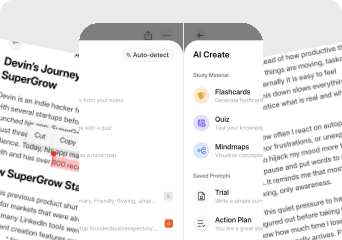
Granola does not have a persistent AI chat interface for querying your note history; reuse is primarily through its structured note format and export to Notion or Markdown. Audionotes supports AI chat across all note types, voice memos, uploaded files, YouTube, and images, giving it a broader second-life surface beyond what was said in a meeting.
Winner : Depends on workflow
Organization

Granola organises notes by meeting and calendar event, making it easy to find a specific call. There is no cross-meeting topic search, tagging system, or folder structure for non-meeting content. Audionotes supports tags and folders across mixed content types, making it more useful as a general knowledge store rather than a meeting-only archive.
Winner : Audionotes
Course Material and File Uploads

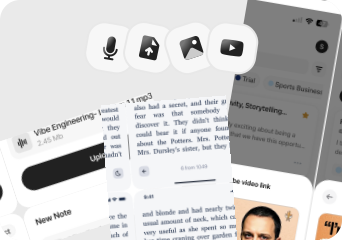
Granola does not support uploading pre-recorded audio files for transcription, it only processes system audio captured live during a Mac session. Audionotes accepts audio uploads, YouTube links, images, and text, giving it a much broader ingestion surface for content that was not captured in real time on that specific machine.
Winner : Audionotes
Export

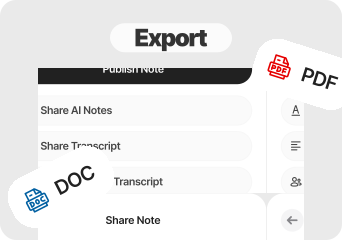
Granola exports to Notion and Markdown natively; PDF export is available on the paid tier. Audionotes exports to Markdown, Text, PDF, and Word, and lets you publish notes as a shareable webpage, more options for content that needs to move outside a local note-taking workflow.
Winner : Audionotes
Online Meetings

Granola automatically detects meetings from your calendar and starts capturing system audio when you join, no bot, no visible participant notification, nothing in the call. The constraint is it only works on a Mac in real time; you cannot capture meetings from a phone, retroactively upload a recording, or use it on any non-Apple device.
Winner : Granola
Integrations


Granola's integration list is intentionally minimal: Notion export is the main outbound connection, with no Zapier, Salesforce, Slack, or WhatsApp support. Audionotes covers Notion, Zapier, and WhatsApp, offering more flexibility for routing notes into other tools or triggering downstream automations.
Winner : Depends on workflow
Privacy and security


Granola's local-first processing is its main privacy argument: audio is transcribed on your device using Whisper and only the text leaves your machine if you use cloud features. Audionotes stores data with GDPR compliance and end-to-end encryption; Granola is the stronger choice if on-device audio processing is a hard requirement.
Winner : Depends on requirements
Best pick by persona
Find your workflow, find your tool.

Mac users in back-to-back meetings
Choose : Granola ↗
Why? : Calendar auto-detect starts recording the moment you join a call, no manual action, no bot, no participant notification.

Users who hand-annotate during calls
Choose : Granola ↗
Why? : Granola layers your in-call typed notes directly on top of the AI transcript, creating a memo format that mirrors how good note-takers already work.

iPhone, Android, or Windows users
Choose : Audionotes ↗
Why? : Granola is Mac-only with no mobile or Windows app, if any recording happens off a Mac, Audionotes is the only option.

People who record outside of meetings
Choose : Audionotes ↗
Why? : Granola only processes system audio during live Mac sessions; it cannot handle uploaded files, voice memos, images, or YouTube.

Content creators and mixed-media note-takers
Choose : Audionotes ↗
Why? : Audionotes accepts YouTube links, images, and uploaded audio alongside voice, Granola is a meetings-only tool.

Privacy-first teams (no cloud audio)
Choose : Granola ↗
Why? : Audio is transcribed locally on your Mac via on-device Whisper, nothing leaves your device unless you export the text.
Pricing and value

$8.33
/month
Billed Annually - $99.99/year
Audionotes is better when you need a general AI note-taking tool, not just a meeting companion.
Its biggest strengths here are broader input flexibility, stronger exports, and a better fit across students, creators, solo professionals, and mixed personal/work workflows
Audionotes offers a free plan and paid plans starting at $19.99/month or $89.99/year.
Audionotes tends to deliver better value if you want one subscription to cover meetings, lectures, voice notes, content drafting, and general knowledge capture.

$14
/month
$168/year
Granola is better when the core requirement is a polished meeting companion for Mac users who spend large parts of the day in conversations.
Its strongest angle is staying out of the meeting while still producing structured notes and action items.
Granola's free plan includes a limited number of meeting hours per month
Granola can be worth paying for if meeting notes are the entire problem you are solving.
Known limitations
No tool is perfect. Here's what to expect.

No native meeting bot or automatic calendar joining
No direct integrations with Zoom, Google Meet, or Teams
Collaboration and sharing features are more limited than dedicated meeting tools
Stronger as a personal capture tool than a team workflow hub

Requires Google Calendar login for some users to even get started, which is a real blocker in Outlook or enterprise environments.
Speaker differentiation is weaker for in-person or multi-speaker conversations than users expect from a meeting product.
The workflow is centered on meetings, so it is less useful for lectures, mixed-media capture, and general note-taking.
Some users report freezes or crashes at the wrong moment, which matters a lot in a notes app you need to trust.
Key takeaway: Granola is quieter and more polished for in-meeting use; Audionotes covers more ground outside the meeting room

Switching from Granola to Audionotes
People usually switch from Granola to Audionotes when they outgrow a meetings-only workflow. The migration itself is mostly about exporting key notes and transcripts, then rebuilding your structure around tags, folders, and reusable outputs inside Audionotes.
Switch if you feel boxed into Granola’s narrower workflow and want one tool to handle ideas, meetings, lectures, personal notes, and mixed-media note creation too. See also: how to record and transcribe meeting minutes. Also evaluating Audionotes vs Fireflies or Audionotes vs Notta? Those comparisons cover similar trade-offs.
FAQ's
Is Audionotes better than Granola?
For cross-platform use, yes. Granola is a Mac-only desktop app, there is no iOS, Android, or Windows version. It captures system audio locally using on-device Whisper, then layers your in-call typed notes on top of the AI transcript. That is a distinctive and privacy-strong workflow, but it only works during live Mac sessions. Audionotes works on mobile, handles uploaded files, and processes YouTube and images, it covers more ground if your recording happens across devices.
Which is better for meeting notes?
Granola is better if you want meeting notes that stay entirely on your Mac with no cloud upload. It listens to your meeting, merges your manual jottings with the audio, and generates a polished local summary. Audionotes requires cloud processing but works on any device.
Does Granola work on Windows or mobile?
No. Granola is Mac-only. Audionotes works across iOS, Android, and the web, which is a significant practical difference for anyone not exclusively on macOS.
Which tool has better integrations?
Granola exports notes to Notion, Slack, and email, and detects meetings automatically via Apple Calendar and Google Calendar. Audionotes connects to Notion, Zapier, and WhatsApp, and exports to Obsidian. For calendar-linked automatic capture without a meeting bot, Granola's calendar integration is more seamless.
Is Audionotes free?
Yes. Unlimited number of notes with 1 minute recording limit. See paid plan features →
Is Granola free?
Yes. Granola's free tier includes AI meeting notes, limited history, AI chat, and shared folders.
Which is better for privacy of meeting content?
Granola, because it processes audio locally on your Mac. No meeting audio leaves your machine. Audionotes is cloud-based, so recordings are processed on Audionotes servers.
What are the best Granola AI alternatives in 2026?
Granola's main strengths are its Mac-native experience, no-bot design, and clean note enhancement layered on top of your own rough notes. The closest alternatives: Audionotes covers meetings plus voice memos, works on iPhone and Android, and is not Mac-only. Fathom is free for individuals, bot-based, but has excellent Zoom integration. Otter.ai works cross-platform with a bot. If the appeal of Granola is specifically the bot-free, hands-on-keyboard note style, Audionotes is the most direct non-Mac alternative.
Is there an AI meeting notes app that works on iPhone, not just Mac?
Yes. Granola is Mac-only, which rules it out for anyone primarily on iPhone or Android. Audionotes has a full-featured iOS app that records meetings and voice memos, generates summaries, and syncs across devices. Otter.ai and Fireflies also have mobile apps, though both use meeting bots for the primary workflow. For a bot-free meeting recording experience on iPhone, Audionotes is the most capable option available in 2026.
What is the best AI note-taking app for MacBook users in 2026?
That depends on whether you want desktop-native or cross-platform. Granola is purpose-built for MacBook: it runs locally, captures system audio without a bot, and produces clean AI-enhanced notes from whatever you type during a call. Audionotes works on Mac through the browser but is primarily a mobile-first product, stronger for capturing outside meetings. MacWhisper is best if you want fully offline, local transcription on Apple Silicon with no cloud dependency. For pure meeting notes on a Mac, Granola is the specialist. For everything else alongside meetings, Audionotes.
Can I switch from Granola to Audionotes?
Yes. Export notes from Granola as Markdown or plain text and import them into Audionotes. Granola does not expose audio for export, so reprocessing requires access to your original source recordings rather than re-using Granola's files. The calendar-linked auto-record behaviour does not transfer, you will record manually in Audionotes. If you are also evaluating Audionotes vs Fireflies, that page compares a bot-based alternative.
Bottom-line verdict
Choose Audionotes if any part of your recording workflow happens away from a Mac desktop, on mobile, from uploaded files, on Windows, or from sources like YouTube. Granola simply does not work in those scenarios.
Choose Granola if you are Mac-only, want no bot visible in your calls, and value local audio processing where your voice never reaches a server. The calendar-detect-and-record model is genuinely frictionless for back-to-back Mac meetings.
Final recommendation: Pick Audionotes if you need notes to follow you across iOS, Android, and the web. Pick Granola if every meeting happens on a Mac, local-first privacy matters, and you want a product that starts recording the moment you join without any manual action.
Other comparisons
Sources
Official Product Sources
App Store and Review Sources
How We Evaluated
We evaluated each product using a mix of official product documentation, pricing pages, privacy and security materials, app store listings, public review data, and hands-on testing where available. We prioritized directly verifiable claims and avoided filling gaps with assumptions.
Where possible, we compared products across the same criteria, including pricing, feature depth, export options, integrations, platform coverage, privacy controls, and review sentiment. If a detail was unclear or not publicly documented, we marked it as unspecified rather than guessing.